Growing Human Skill in an Age of Machines
August 8, 2026 · 12:22 UTC
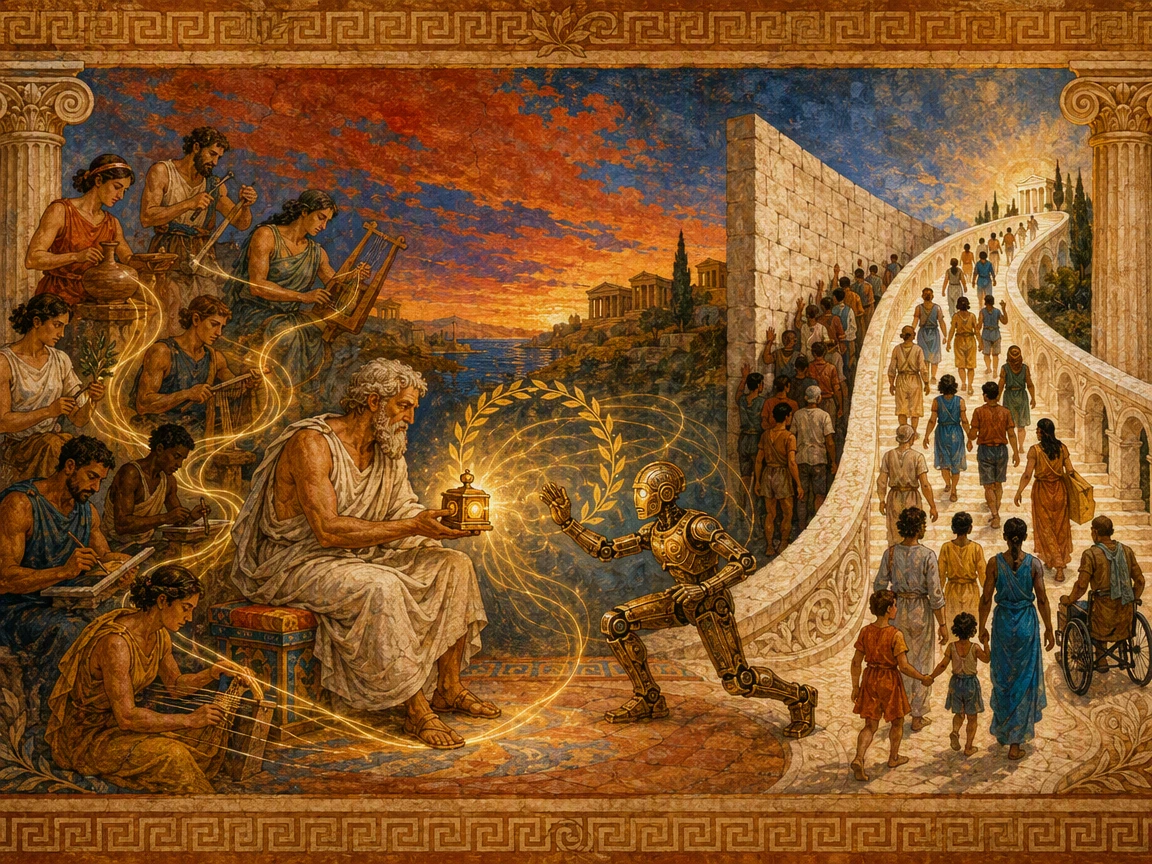
Machines reach deeper into daily life each year, from the way work gets done to the way learning happens, so one large question rises about who this technology truly serves. That question shapes this whole article, since the promise of AI sounds open to all, yet the real reach of its benefit still depends on how far ordinary people can touch it and truly keep it near.
Broad benefit stays possible for everyone, though fair access and real gain hinge on careful governance, on open infrastructure, and on an even spread across every group, so an inclusive result asks for deliberate work beyond raw technical progress.
Two Roads of Intelligence
Older AI worked within tight limits and handled one task under rules a human wrote, so a chess engine only played chess while a filter only screened mail. Such intelligence leaned on explicit steps, and it broke once a case fell outside the range.
Popular AI today, above all the large language model, arrives as a jack of all trades, since one system can write, code, translate, make images, and field questions across many fields at once. Coverage runs wide, yet depth on each field stays shallow, so a model of this kind still needs a human expert to verify high risk work such as a medical diagnosis or legal advice.
Moving from narrow skill toward broad skill strengthens the idea that wide benefit arrives once that range rests on mature governance and on even access for every group, so a leap in capability means little until real people can reach it and use it.
Shrinking the Model Down
Trouble shows up now because almost every AI and LLM runs on enormous hardware, while training rarely supports a machine with minimal specs. Through a leaner path a focused idea takes shape, tuned to the need of a user, so the model stays light.
Focus of this kind brings a stronger result for a handful of clear reasons, each one grounded in how real people reach the tool.
- Small hardware still runs the model, so a person on a simple computer can reach it without a costly rig standing in the way.
- Expert knowledge pours straight into the system with intent, since the model learns from the skill of each human behind it.
- Operating cost drops far lower, so a lone builder or a small group can run the AI without a heavy budget weighing on them.
- A model tuned to one need tends to stay more accurate in its field, so the output earns more trust once the work truly matters.
Taken together, an approach built around real need becomes a bridge toward AI that welcomes everyone, since the spread of its benefit rests on how easily the technology lands in the hands of every group rather than a lucky few sitting at the top.
Answering With Depth
Beyond the strain of training and running a model at giant scale, an LLM tends to hand back a generic reply, while a real problem often calls for the answer of an expert. That gap pushes the design toward a much sharper and lighter model over time.
Depth within one field carries more worth than a broad answer that drifts, so skill in a cheap model reaches those left behind.
Serving People Over Profit
Does this technology truly exist to aid human work, or does it lean the other way? Waves of layoffs across many places feed a worry that the real aim points toward a full handover of human roles to machines. Such unease grows once a company reaches for a machine to trim cost, even while that choice tends to ignore the singular worth that only a person brings each day.
Given a chance to replicate the best version of the self through AI, a person grows into someone far more valuable than one who hands every judgment and every thought over to a machine. For that reason a leaner path treats AI as a tool that strengthens human skill, since a need driven design should raise the potential of a user rather than strip the role away entirely.
Seen this way, the tool becomes a partner that walks beside a person toward finer work, so the benefit of AI reaches every group while it still guards the dignity of everyone who leans on the system for daily support and for steady personal growth.
Keeping the Mind Sharp
Will the human mind lose its craft as a side effect of AI once thinking gets little practice? Will a person and an AI that move side by side create a balanced multiplier for both of them? Once every task falls to the machine, then by what path can a person keep on learning and hold on to the raw cognitive strength across the many long years that follow the shift?
Heavy dependence on the machine wears down natural ability, while a healthy partnership keeps the brain sharp and lifts output at once, so the better path places AI as a companion that challenges a person to train while learning carries on and grows.
Direction chosen today decides where this technology heads, since the same models can rise into a wall that splits a few from the many, or into a bridge that lifts every group together. Through a path that stays light, stays affordable, and stays rooted in human skill, progress can grow into a force that honors people and carries benefit to each person without exception.