When to Own Your AI and When to Rent One
July 4, 2026 · 06:54 UTC

Picking between a rented cloud model and a local deployment turns into a quiet argument with the budget, where the real question is never which one wins in pure theory but when each option earns its keep for the actual workload a team faces now.
Both paths carry a real price tag, so the honest call rests on how long a model runs and how heavily the pipeline leans on AI.
Standing on Owned Metal
Building infrastructure runs far from cheap, and a compliant frontier model can climb toward two or three hundred thousand dollars once the full stack is counted, from the GPUs and servers to the networking, cooling, rack space, and redundancy that keep the cluster alive on the day one single card fails and the workload still has to answer every incoming request.
GLM-5.2 makes a clean case study, a 753B mixture of experts with 40B active parameters, a one million token context, and a 1.51 TB weight in BF16, where KV cache and activation overhead near twenty percent push the memory target past 1,780 GB VRAM.
Renting Racks by Month
Cloud pricing folds that memory target into a monthly bill whose shape depends on which card fills the racks, and the table below sizes GLM-5.2 across each option, rounded up to the unit count that holds the entire 1,780 GB inside memory at once.
| GPU | VRAM | Units | Rent/mo/unit | Total/month |
|---|---|---|---|---|
| H200 | 141 GB | 1780 / 141 = 13 | $2,872.80 | $37,346.40 |
| DGX B200 | 180 GB | 1780 / 180 = 10 | $3,952.80 | $39,528.00 |
| H100 NVL | 94 GB | 1780 / 94 = 19 | $2,210.40 | $41,997.60 |
| A100 SXM | 80 GB | 1780 / 80 = 23 | $1,072.80 | $24,674.40 |
| A100 PCIe | 80 GB | 1780 / 80 = 23 | $1,000.80 | $23,018.40 |
Crossing the Break-Even Line
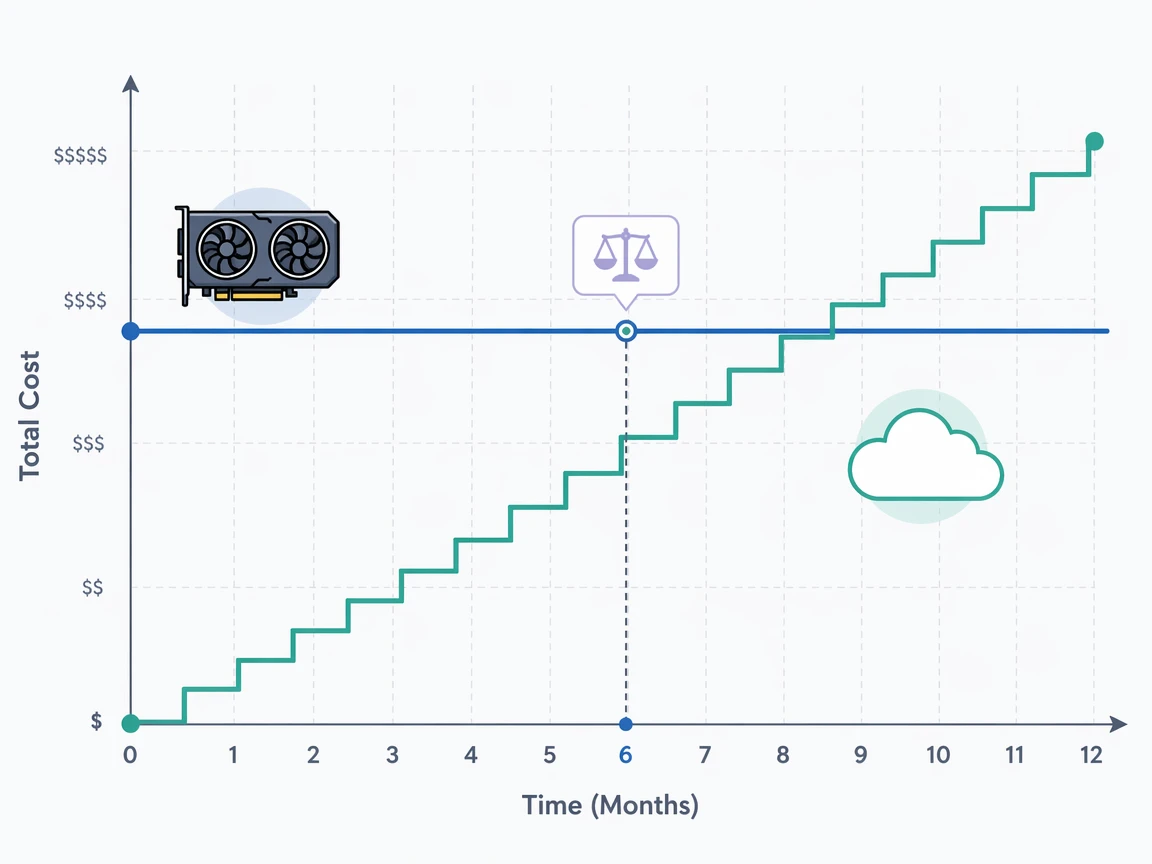
Renting stays smarter while the horizon is short, since the upfront outlay lands lower and nothing sits idle when the work pauses, yet the balance tilts once a large model runs beyond six continuous months and the rent keeps arriving every month.
Break-even is a projection, not a fixed date, so a short burst favors the cloud while a long steady run favors owned hardware.
Counting a Live Bill
Numbers from a live trial sharpen the picture, where a swarm of AI workers filled roles across programming, security, and public relations, orchestrated by @neaswarm nonstop around the clock, and the bill reached roughly 5,500 dollars a month, close to a hundred million rupiah, a figure that looks heavy until it sits beside the salary of one capable senior human hire.
Raw token counts mislead, so the cost should never be read straight from usage, because a smart semantic cache drove hits past ten billion after clearing 2.2 billion in a single week, cutting spend across providers while the shipped quality held.
Claude Opus 4.8 powered the trial, and a cheaper provider drops the rate, so this figure marks a real ceiling, not a floor here.
Trusting a Silent Log
Cloud always stores the data, and a retention window is a promise rather than a guarantee, because every layer along the path handles the payload in the clear, the HTTP log, the application log, and the firewall log, so no one can honestly swear that each of those layers stays fully clean, never reads the content, and keeps no quiet copy anywhere down the whole stack.
That risk is the true cloud price, and it never shows up on the invoice, so owning the model keeps the data on the metal and trades away speed for control, a call decided only by how sensitive the work moving through the whole pipeline really is.
Matching Scale to Choice
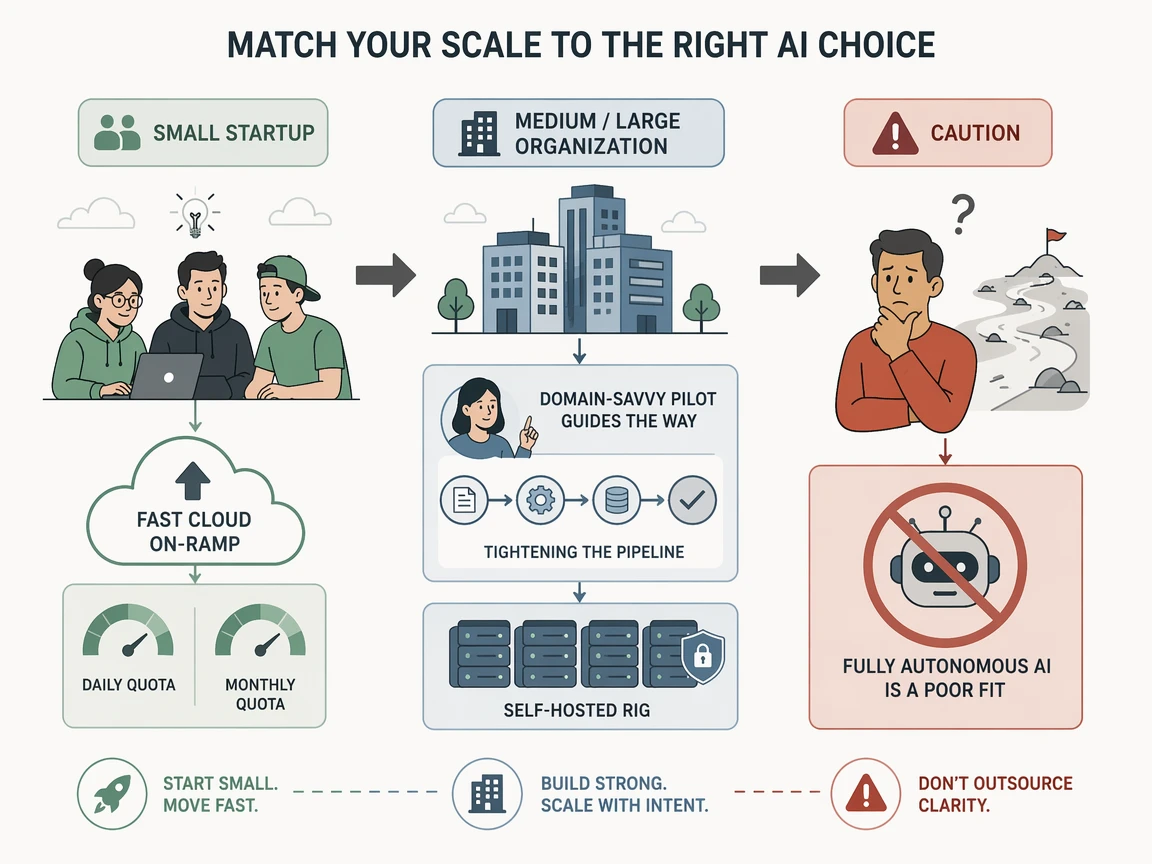
Cloud fits a team chasing speed on a small outlay, the very same rhythm the industry runs on with its daily, weekly, and monthly quota, an on-ramp a self-hosted rig cannot match, though the convenience is repaid through the privacy risk it carries.
Self deployment earns its cost for a medium or large organization that leans heavily on AI and wants to tighten its pipeline, provided the pilot understands the domain, while fully autonomous AI remains a poor fit for a business that is still finding its own feet, so the decision comes down to the real scale, the horizon ahead, and how firmly the data must stay home.