Component Soup Slowly Kills the Frontend
November 17, 2025 · 08:00 UTC
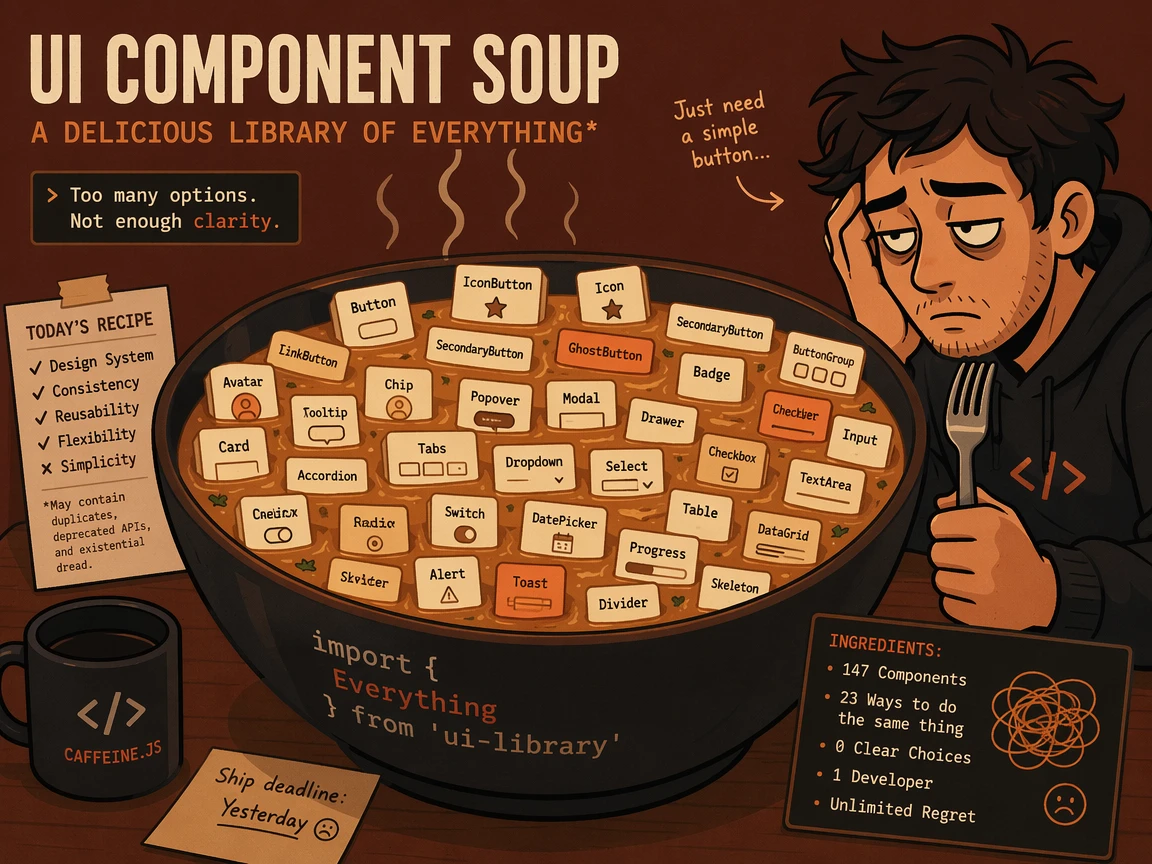
Frontend codebases that start out with clear and honest boundaries can quietly turn into a thick bowl of tiny components, each one carefully justified by reuse or by separation of concerns, until the team finally realizes that changing a single button now means touching fifteen scattered files and updating stale tests across three unrelated directories all at once.
This slow drift is component soup, and it never once announces itself out loud, it just quietly grows one atomic design layer at a time until the entire project slowly drowns under a thick layer of abstraction that no longer serves the real product.
The intention behind each small component was good, yet the cumulative effect is a whole system where little fits together well.
The Reuse Trap
Developers are carefully taught to make almost everything reusable, so every button, input, and card quickly becomes its own separate little component, but real reuse turns out to be genuinely rare and the ongoing cost of maintaining a component built for one lonely use case is quietly paid over again every single time the surrounding requirements happen to shift.
Reusability should always be earned through repeated real use, never once simply assumed by default right from the very start.
A component that only ever exists for one single screen is not truly reusable, it is really just plain indirection, and that indirection quietly multiplies the number of places a developer must look before understanding what the page actually does.
Prop Drilling Becomes Normal
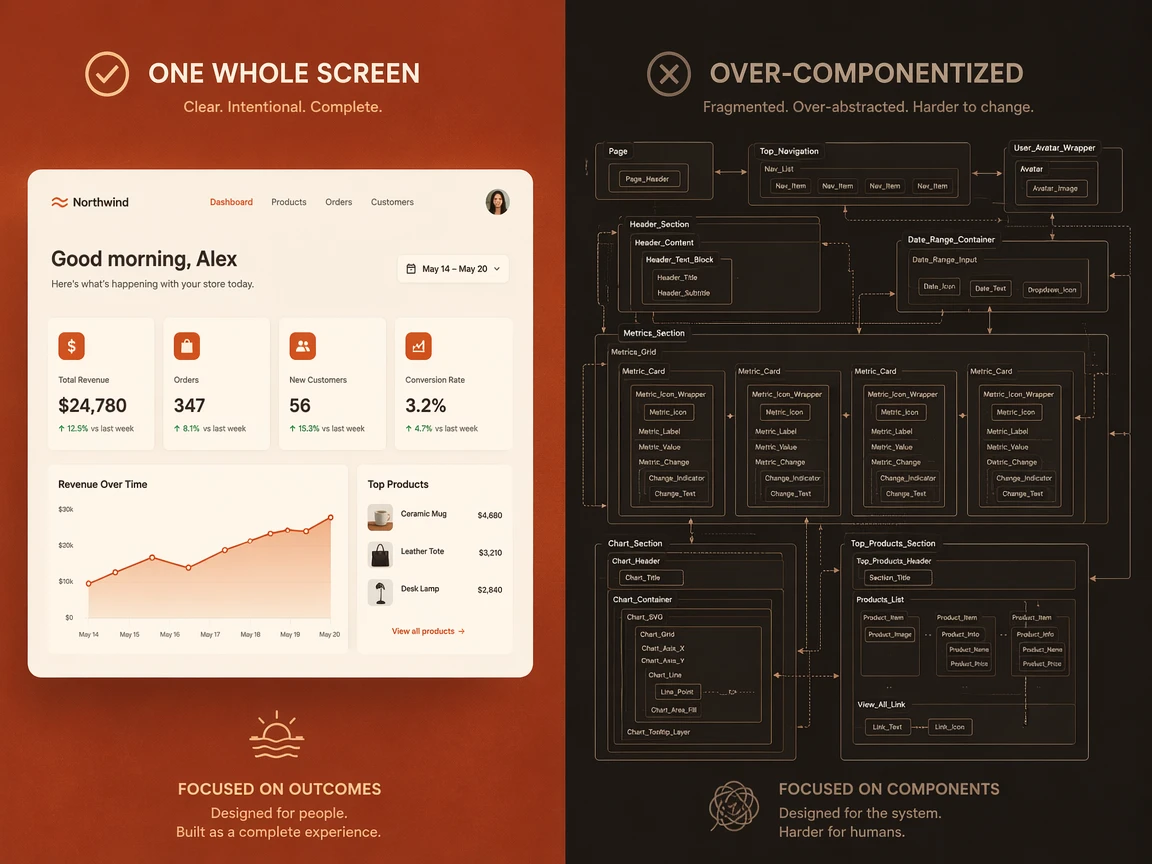
When components are made far too small, data suddenly has to travel through many layers that never truly need it at all, and each passing layer adds fresh props, extra types, and forwarding logic that slowly obscures the original purpose of the page.
The code looks impressively clean in isolation, every single file stays short and appears to own a single clear responsibility, yet the team quietly spends far more time tracing long prop chains than actually building the new features, because the whole architecture has carefully optimized only for tiny file size instead of any real, honest feature clarity at all.
A page should always be able to explain itself far faster than its own deeply tangled and nested component tree ever really does.
Refactoring Turns Into Archaeology
The quiet fear of breaking something invisible slowly pushes developers to wrap existing components rather than improve them.
Changing even one small feature inside a thick soup of components quietly requires reading straight across many directories, patiently understanding naming conventions that almost no one follows consistently anymore, and then nervously guessing whether a given prop is still genuinely used somewhere or was simply left behind and never actually removed by anyone at all.
Velocity almost never dies in one dramatic big rewrite, instead it quietly erodes one small and harmless looking abstraction at a time, and each brand new wrapper only adds yet another fragile layer onto an already deep and shaky component stack.
Cohesion Beats Granularity
A healthier frontend quietly groups its code by feature rather than by raw atomic size, because a feature that fully lives in one single place is far easier to read, easier to test, and easier to delete outright whenever the product finally changes.
Components should always be large enough to represent a genuinely meaningful and self-contained piece of the whole user interface, and small components should only ever emerge naturally once the very same piece truly appears once again in several genuinely different places across the product, not merely because some passing style guide happened to suggest it once.
The real goal is never simply fewer components, it is components that hold firmly together under the daily pressure of real work.
Taste Matters More Than Rules
There is really no universal rule for the exactly right component size anywhere, yet there is one very clear and honest sign that the whole balance has quietly gone wrong, which is that the entire team openly dreads even the simplest possible changes because the work now stubbornly spreads itself thin across far too many scattered little files all at once every time.
Good component boundaries should quietly match the actual real shape of the product itself, not the taxonomy of a design system.
A frontend that genuinely moves fast is always one where the underlying code honestly feels a lot like the very interface it quietly renders out onto the screen, staying clear, whole, and always easy enough for a new team member to follow along.